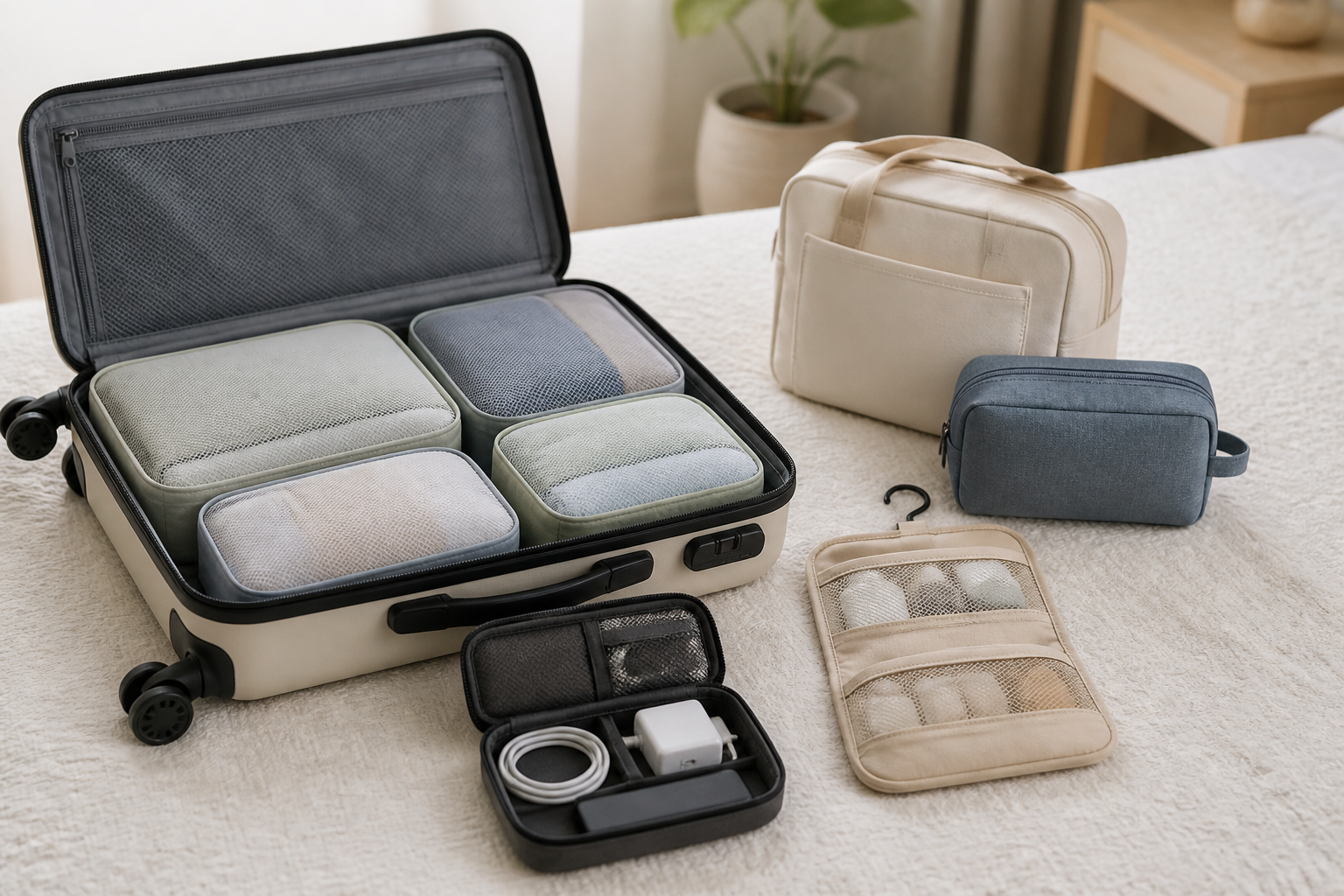
A small carry-on is not automatically an organized carry-on. The wrong collection of organizers can steal usable space, add needless weight, create an awkward bag shape, and make airport screening slower. The useful approach is to build a packing system: a few pieces that match your bag’s dimensions, your itinerary, and the items you need to reach first.
For most budget-conscious travelers, the best system is not a giant matching set. It is usually two or three slim organizers inside a bag that already fits the airline’s allowance. Start with the bag, then choose organizers to solve specific problems: clothing volume, liquids access, cable clutter, or sharing one carry-on with a child.
Start with the bag allowance, not the organizer
Personal-item rules are especially important because under-seat space varies by airline and aircraft. For example, American Airlines publishes a personal-item maximum of 18 x 14 x 8 inches, while Delta describes a personal item as one that fits beneath the seat and lists a larger overhead carry-on limit. A bag marketed as “personal-item size” is not a guarantee for every flight.
Buying rule: measure the inside of the bag you will actually use. Do not add up the advertised capacity of several organizers. A cube that is technically small enough can still be a poor fit if its rigid edges turn the bag into a bulky rectangle.
| Trip style | Best starting system | What to avoid |
|---|---|---|
| Personal-item-only weekend | One medium clothing cube, one small underwear/laundry pouch, one flat liquids bag | Large compression sets and deep, boxy toiletry bags |
| Standard carry-on for 3–5 days | Two clothing cubes, a toiletry case, and a slim tech pouch | Duplicating compartments already built into the suitcase |
| Family carry-on | Color-coded or labeled cubes by person, plus one quick-access snack or activity pouch | Mixing each traveler’s clothes in one large cube |
| Work trip with laptop | Front-access personal-item bag, clothing cube, and narrow cable organizer | A bulky electronics case designed for many chargers you will not bring |
| Low-tech or digital-detox trip | Clothing cube, toiletries pouch, document pouch, and a minimal charging sleeve | Buying a structured tech organizer out of habit |
Compression packing cubes: buy them for containment first
Compression cubes are most helpful when clothing is soft, flexible, and already reasonably compact: T-shirts, lightweight layers, underwear, socks, workout clothing, and children’s outfits. Their biggest everyday benefit is often containment. You can remove one cube at a hotel without unpacking the whole bag.
Compression does not create unlimited space. It squeezes air from garments, but dense items such as jeans, shoes, chargers, and toiletries do not compress much. Overfilling a compression cube can also make it hard to slide into a personal item and can stress its zipper.
Choose compression cubes when
- You pack soft clothing and want to separate outfits, activities, or travelers.
- Your bag is a little deeper than your clothes load, leaving empty pockets of air.
- You want a simple “one cube out, one cube back” hotel routine.
- You are willing to use fewer, better-fitting cubes rather than every piece in a large set.
Skip compression cubes when
- Your bag is already tightly packed with rigid items.
- You wear bulky cold-weather layers that become dense, heavy blocks when compressed.
- You need frequent access to individual garments during transit.
- A standard cube or drawstring laundry pouch would solve the organization problem more cheaply.
What to inspect before buying
- Compression zipper path: A full perimeter zipper generally distributes tension better than a short, awkward secondary zipper.
- Fabric balance: Very thin fabric saves weight; excessively flimsy fabric can snag or expose clothing to rough zipper teeth.
- Mesh placement: Mesh helps identify contents, but too much mesh can be less useful for damp or spill-prone items.
- Cube depth: For a shallow personal item, flatter cubes are usually more valuable than tall cubes.
- Realistic set sizes: A small and medium cube may be more useful than a set dominated by large suitcase-oriented pieces.
Personal-item bags: prioritize shape, access, and honest capacity
The best under-seat bag is not necessarily the one with the most pockets. It is the one that stays within your airline’s limits when packed, opens without spilling into the aisle, and lets you retrieve essentials without excavating your clothing.
Look for a bag with a main compartment that accepts your largest clothing organizer without forcing it into a curved or tapered corner. Then use the exterior or top-access pocket for documents, medication, headphones, a snack, and a small charging cable. This arrangement protects the clothing compartment from constant rummaging.
Personal-item bag checklist
- Compare the fully packed external dimensions, including feet, handles, and stuffed pockets, with your specific airline’s rule.
- Favor a wide opening over a tall, narrow cavity if you use packing cubes.
- Choose a luggage-pass-through only if you also use a rolling carry-on; otherwise it adds little value.
- Make sure the laptop compartment does not consume so much depth that the main compartment becomes impractical.
- For soft-sided bags, leave a margin below the size limit rather than planning to overstuff the fabric.
Practical test: put a folded sweatshirt, your usual electronics, and a filled clothing cube in the bag. If it bulges beyond its clean rectangular shape, it is too small for your real travel load even if its stated capacity sounds generous.
Toiletry cases: optimize for security screening and small bathrooms
A toiletry case should make liquids easy to isolate, not hide them behind multiple layers. In the United States, carry-on liquids, aerosols, gels, creams, and pastes generally need to comply with the TSA 3-1-1 rule: containers of 3.4 ounces or less, in one quart-sized clear zip-top bag per passenger. That means a beautiful hanging toiletry bag may still need a separate removable liquids pouch for airport screening.
For a personal-item-only trip, choose a small, flat, wipeable case for solids and makeup tools, then keep compliant liquids in a clear removable bag. For hotel stays with tiny counter space, a hanging model can be worthwhile only if it has a dependable hook and stays compact when filled.
Choose the toiletry format by use case
| Format | Best for | Watch out for |
|---|---|---|
| Clear removable liquids bag | Fast security access and personal-item travel | Weak seams, inflexible plastic, and oversized proportions |
| Flat zip toiletry pouch | Solid toiletries, makeup, and simple routines | Items becoming hard to find if the pouch is too deep |
| Hanging toiletry case | Longer trips and bathrooms with little counter space | Bulky built-in compartments and a weak hanging hook |
| Small dopp-style bag | Minimal kits with a few sturdy items | Rounded shape wasting space in a shallow backpack |
Keep medications, required medical liquids, and essentials you cannot replace in an easy-to-reach location. TSA allows certain medically necessary liquids in quantities above the usual limit, subject to screening; check current guidance before departure.
Tech organizers: buy smaller than you think
Many travelers overbuy tech organizers. A large, padded case can be sensible for several adapters, a mouse, camera batteries, storage media, and a laptop charger. But for a phone, cable, wall plug, and earbuds, a slim pouch or cable wrap leaves more room for clothing and reduces the “brick” effect at the bottom of your bag.
A tech organizer earns its space if it does at least one of these jobs
- Keeps small essentials from falling loose into the bag.
- Separates cables from liquids and snacks.
- Lets you remove your charging kit in one motion at a seat, lounge, or hotel desk.
- Protects delicate accessories without adding excessive padding.
Buy by your device list, not by the number of elastic loops
- Lay out every device and cable you will take.
- Remove duplicates, “just in case” adapters, and cables for devices you will not use.
- Measure the thickest item, usually a charging brick or power bank.
- Select the shallowest organizer that closes comfortably around that item.
- Keep the pouch in the same location on every trip so airport and hotel access become automatic.
Remember that spare lithium batteries and power banks have airline-specific rules. Check both your airline’s current battery policy and TSA guidance before packing.
Build a budget system in the right order
You do not need to purchase everything at once. Solve the failure that happens most often on your trips, then add only the organizer that fixes it.
- First purchase: a bag that fits your most restrictive airline allowance and opens well.
- Second purchase: one clothing cube or simple pouch sized to the bag’s main compartment.
- Third purchase: a compliant clear liquids bag or a compact toiletry pouch, depending on your routine.
- Fourth purchase: a slim tech organizer only if cables regularly become tangled or lost.
- Optional purchase: a laundry pouch, shoe bag, or second cube for longer trips or shared family packing.
Recommended option types to compare
Use our recommended options below as a shortlist, then compare the dimensions and layout against your own bag before choosing. The best value usually comes from buying the smallest system that handles your actual packing list.
- Flat compression packing cube sets with small and medium sizes
- Personal-item travel backpacks with a clamshell or wide-opening main compartment
- Under-seat travel bags with a separate but not oversized laptop sleeve
- Clear TSA-style liquids bags with reinforced seams
- Compact hanging toiletry cases with a removable liquids section
- Slim cable organizers for a phone, earbuds, power bank, and one charger
- Color-coded packing cube sets for family carry-ons
The quick decision
Choose compression cubes if loose clothing is your problem. Choose a better personal-item bag if your current bag bulges, is hard to open, or wastes under-seat space. Choose a clear or flat toiletry solution if security screening or bathroom clutter frustrates you. Choose a tech organizer only if it replaces a recurring tangle of small electronics rather than becoming another bulky container.
The winning small carry-on system feels almost invisible: everything has a home, the bag closes without force, and you can find what you need without unpacking at the gate.