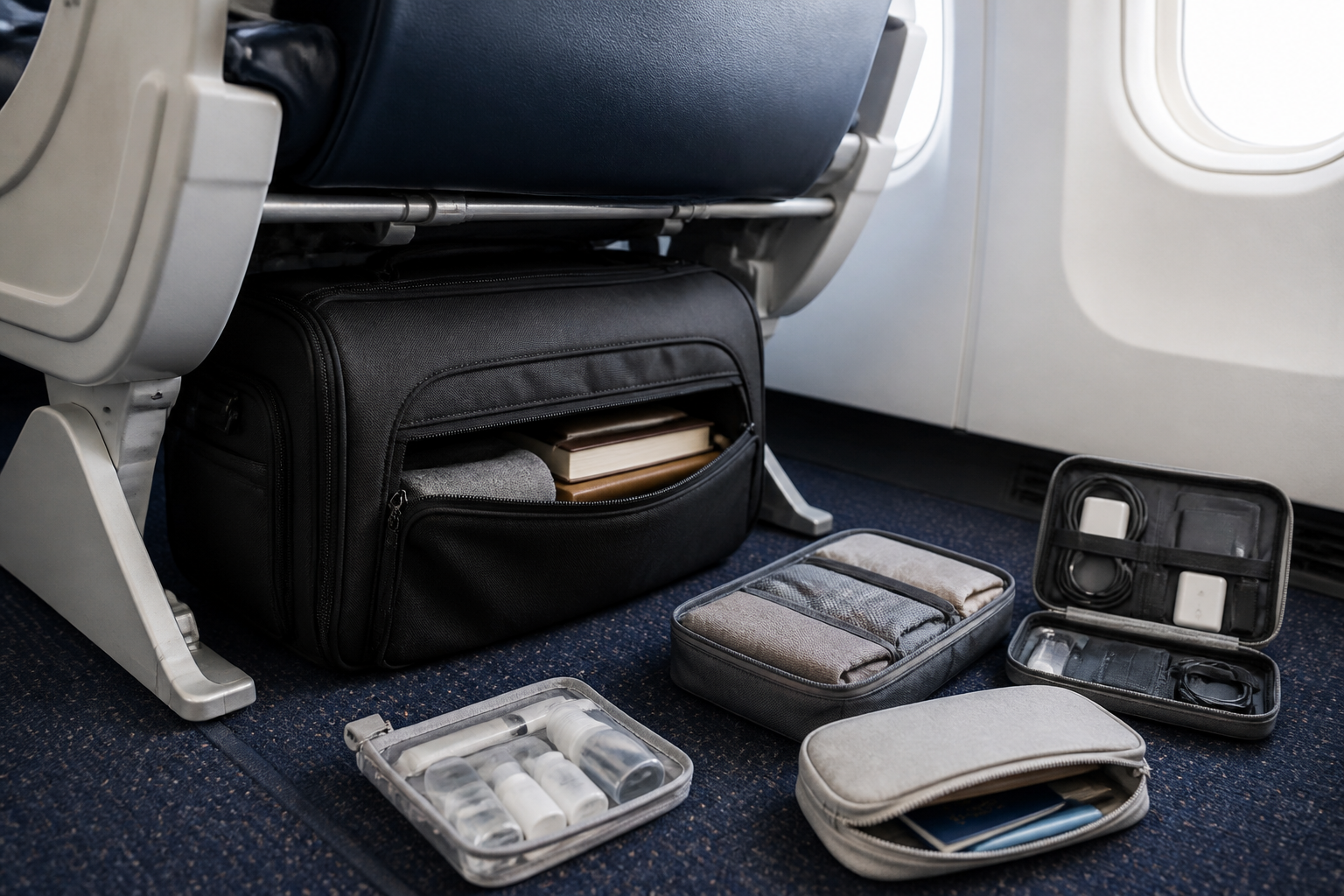
Flying with only a personal item can be one of the most reliable ways to control travel costs—but only when the bag still fits after it is packed. The best option is not necessarily the largest backpack or the bag with the most pockets. It is the one whose fully packed exterior dimensions, including straps, wheels, handles and bulging front pockets, stay within the rule for the airline and fare you actually booked.
That distinction matters. A compression cube can reduce the volume of clothing inside a bag, but it cannot make an overstuffed bag’s outside depth disappear. Start with the airline limit, buy a bag with a little dimensional margin, and use organizers to make the limited space easier to live out of.
Start with the airline—not the product label
“Personal-item sized” is a marketing phrase, not a universal standard. Airlines can use different dimensions, may measure including exterior parts, and can apply restrictions based on aircraft or itinerary. Verify the policy in your reservation before you pack, especially for a codeshare or regional flight.
| Airline example | Published personal-item guidance checked August 28, 2026 | What it means when choosing a bag |
|---|---|---|
| American Airlines | Up to 18 x 14 x 8 inches, and it must fit under the seat in front of you. | A soft-sided backpack or compact tote can work well, but the stated dimensions include the packed shape—not just the empty shell. |
| Frontier Airlines | Up to 14 x 18 x 8 inches, including handles, wheels and straps. | Prioritize an 8-inch-or-less depth and avoid a bag that expands substantially when full. |
| Delta Air Lines | One personal item is permitted and should be similar in size to an item that fits beneath the seat in front of you. | Choose a compact bag rather than treating the lack of a posted numeric personal-item limit as permission to overpack. |
Important: Do not assume a bag acceptable on one airline will work everywhere. If you frequently fly an airline with a smaller allowance, purchase to that stricter limit rather than hoping a larger bag will be overlooked.
The bag dimensions that matter most
Compare the manufacturer’s external measurements with your airline allowance. Interior capacity, liters and “fits a weekend’s worth of clothing” claims are secondary. A bag can have an appealing capacity figure yet fail because of a rigid laptop section, protruding water-bottle pocket, thick handle or packed front organizer.
- Depth is the danger dimension. A bag that is only slightly too deep can become difficult to place in an airport sizer or beneath the seat. For strict 8-inch limits, seek a bag that stays below that measurement when loaded.
- Soft sides are useful only when controlled. Flexible fabric can help a bag conform slightly, but an unsupported, overfilled bag often balloons beyond its listed dimensions.
- Expansion is a tradeoff. An expansion zipper is helpful after arrival, but it is a poor feature to rely on at boarding. Keep it closed for the flight.
- External pockets count in practice. A nearly empty front pocket is convenient; a fully loaded one can be the difference between fitting and not fitting.
- Wheels cost usable space. Wheeled underseat bags can be convenient, but wheels and handle assemblies consume dimensions and reduce interior flexibility. They are usually a less forgiving choice for the strictest personal-item limits.
Which underseat bag style is right for you?
| Traveler profile | Best bag style to consider | Features worth prioritizing | What to avoid |
|---|---|---|---|
| Strict-limit budget flyer | Compact, non-expanding travel backpack | Clearly published exterior measurements, soft sides, tuck-away straps, clamshell opening | Oversized laptop compartments, rigid frames, thick padded exterior pockets |
| Weekend city traveler | Small clamshell backpack or structured duffel | Wide-opening main compartment, luggage pass-through, separate toiletry section | Deep barrel-shaped duffels that become hard to measure when packed |
| Remote worker | Compact laptop backpack | Padded laptop sleeve, quick-access document pocket, cable organization, restrained depth | Buying a large commuter pack and assuming it is an underseat bag |
| Parent or caregiver | Organized backpack with flexible interior | Easy-access essentials, wipeable lining, room for permitted child-related items | Relying on loose items that must be consolidated at boarding |
| Traveler with mobility concerns | Lightweight backpack with comfortable harness | Low empty weight, wide shoulder straps, stable base, easy-grab top handle | Heavy bag construction that leaves little practical carrying capacity |
The accessory system that actually helps
Accessories should make a small bag more usable, not turn it into a collection of extra containers. Our recommended options below should be chosen as a system around your bag and trip length.
Compression packing cubes: useful, but not magic
Compression cubes work best for soft, bulky clothing such as T-shirts, knitwear, underwear and light layers. They help create a flatter, more orderly load and can make repacking faster. They are less useful for stiff garments, shoes, toiletries and electronics.
Choose one or two slim cubes for a personal-item trip rather than a full multi-cube set. Overly thick cubes can create hard rectangular blocks that waste corners and force the bag outward. Roll or fold clothes consistently, fill the cube only to the point where its zipper closes without strain, and place the densest cube closest to your back.
A hanging toiletry bag: buy for access, not maximum capacity
A compact toiletry organizer is valuable because it prevents small items from spreading through the bag. Look for a shape that lies flat when packed and has a removable or clearly separated liquids pouch. For U.S. airport security, carry-on liquids, gels, aerosols, creams and pastes generally need to follow the 3-1-1 rule: containers of 3.4 ounces or less inside one quart-sized clear zip-top bag.
Skip oversized hanging kits for personal-item travel. Decant products, use solids where practical, and pack the liquids pouch near the top or in an accessible pocket for screening.
A slim tech organizer: protect access to essentials
For travelers carrying a phone charger, cable, earbuds, adapter and storage media, a thin zip pouch is often better than a bulky “travel tech case.” The goal is to prevent cable tangles and make it easy to move essential electronics if a larger carry-on must be gate-checked.
- Use elastic loops or small interior dividers for cables.
- Keep the pouch shallow enough to lie flat against the bag wall.
- Reserve quick-access space for passport, medication, headphones and charging cable.
- Do not fill every organizer pocket merely because it exists.
Power banks: choose one you can keep with you
A compact power bank is practical for delays and tight connections, but it should be easy to remove and retain in the cabin. FAA guidance says spare lithium batteries and power banks must travel in carry-on baggage, not checked baggage. If a bag is gate-checked, remove them and keep them with you. Check the watt-hour marking and your airline’s current battery policy before flying; airlines may set stricter limits.
A luggage scale: best for travelers who sometimes add a paid bag
A compact digital luggage scale does not solve personal-item sizing, but it is useful if your itinerary includes a carry-on or checked bag on one direction of the trip. It is a low-priority accessory for an all-personal-item traveler; a tape measure is more relevant. If choosing between the two, buy the tool that addresses your likely failure point.
A practical buying checklist
- Find the smallest applicable airline limit. Check every operating carrier, not just the airline that sold the ticket.
- Subtract a margin. Do not shop for a bag that matches the maximum dimension exactly. Leave room for seam variation and a packed bag’s natural bulge.
- Read exterior measurements carefully. Confirm whether the stated size includes straps, wheels, handles and pockets.
- Match the laptop compartment to your actual device. A larger padded sleeve can make a compact bag unnecessarily rigid.
- Choose the opening style around your packing habits. Clamshell openings simplify clothing access; top-loading bags are often quicker for commuting but harder to repack neatly.
- Check empty weight. The heavier the bag itself, the less pleasant it is to carry through an airport.
- Test-pack before the return window closes. Pack the clothing, toiletries and electronics you would bring for a typical trip; close every zipper and measure the outside at its widest points.
How to fit several days into a personal item
The sustainable approach is not packing a different outfit for every possible scenario. Build a small wardrobe where every top works with every bottom, wear the bulkiest shoes and layer in transit.
- Pack two bottoms, three to five tops, underwear and socks for the trip length, one sleep layer, and one weather layer appropriate to the destination.
- Wear the heaviest footwear, jacket and denim rather than placing them in the bag.
- Use one slim compression cube for clothing and leave a little room for the return journey.
- Place shoes in a thin bag at the bottom only if they are essential; otherwise wear one versatile pair.
- Keep liquids, documents, medication and charging items accessible.
- Before leaving for the airport, close expansion panels, flatten exterior pockets and tighten loose straps.
Common mistakes that create baggage-fee risk
- Buying based on a generic “airline approved” label instead of published external dimensions.
- Assuming an empty bag measurement is the same as a fully packed bag measurement.
- Using compression cubes to justify carrying more than the bag can contain within its outer dimensions.
- Filling an exterior water-bottle pocket, then forgetting it changes the bag’s profile.
- Carrying a separate shopping bag, pillow or loose jacket without checking whether it must be consolidated.
- Putting power banks or spare batteries in a bag that might be gate-checked.
- Failing to check a partner-airline or regional-flight restriction before departure.
Bottom line
For the best odds of avoiding a bag surprise, choose a lightweight, non-expanding, soft-sided underseat backpack with clearly stated exterior dimensions below your airline’s limit. Add only the accessories that solve a genuine packing problem: one or two slim compression cubes for clothing, a flat toiletry solution for screening, and a compact tech pouch for essentials.
The smartest purchase is a bag that is slightly smaller than the maximum and still works for your normal travel routine. That margin is more valuable than an extra pocket when your goal is to board confidently with everything under the seat in front of you.