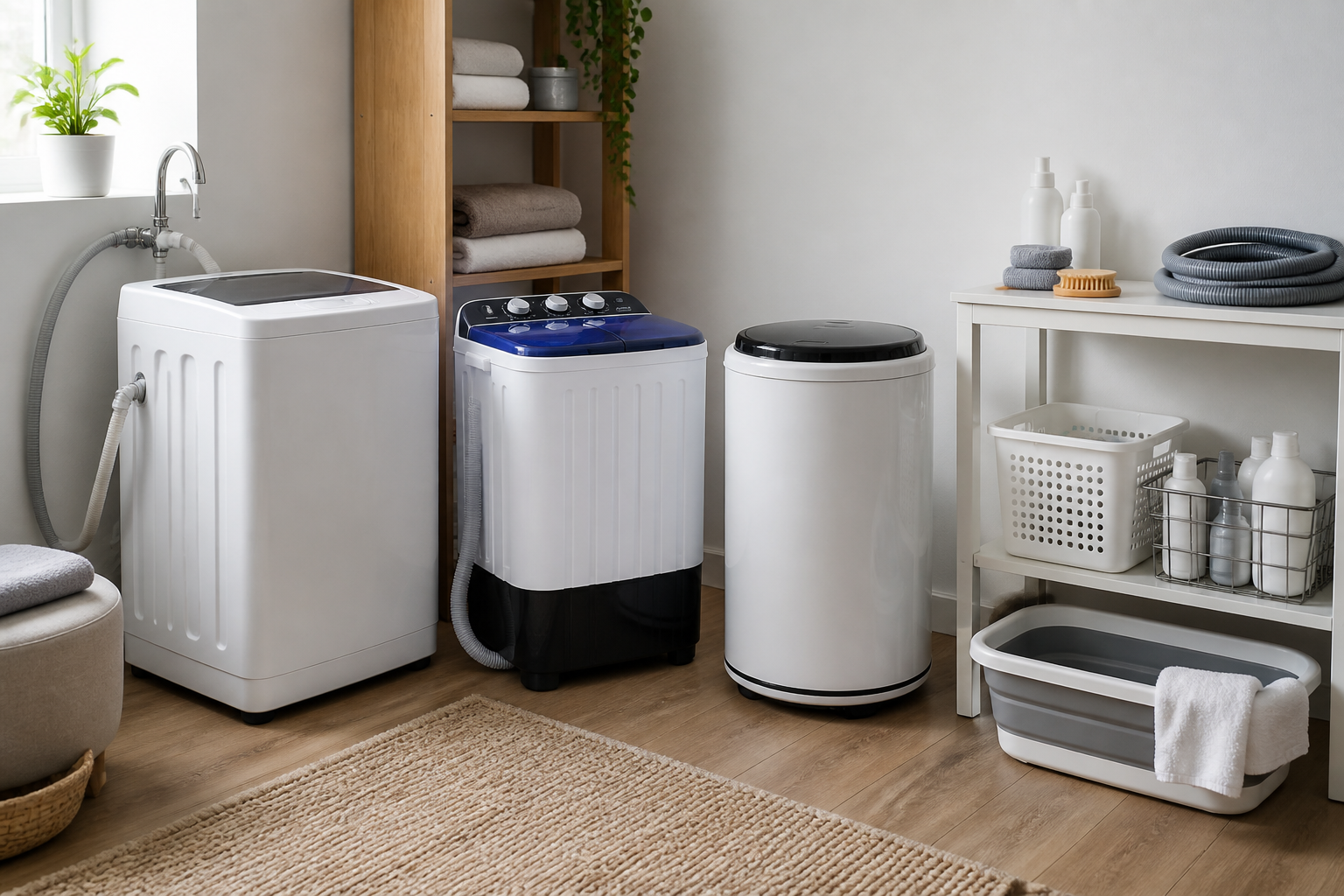
The basket is full, the building laundry room is busy, and a portable washer is sitting in an online cart. Before checking out, pause at the point where many apartment setups fail: not during the wash cycle, but when the machine needs water, has to drain, or leaves a rack full of clothes with nowhere to dry.
A portable laundry appliance can make routine loads easier, but it is not automatically a replacement for every laundromat trip. The useful first question is not which machine has the longest feature list. It is what is stopping you from doing laundry comfortably now? Once that problem is clear, the right route may be an automatic washer, a hands-on twin-tub unit, a spin dryer, or simply a better drying system.
Identify the part of laundry day that breaks down
Start with a quick diagnosis. A product that solves one frustration can create another if it does not fit the apartment’s water path and drying capacity.
- The shared laundry room is the problem: Consider a faucet-connected automatic portable washer if you regularly wash small or medium clothing loads and can supervise each cycle.
- Storage space is the problem: A twin-tub or semi-automatic model may suit you if you can actively fill, drain, transfer, and put the unit away after use.
- Air-drying takes too long: Look first at water extraction and drying space. A standalone spin dryer and a better rack can improve the routine more than another wash appliance.
- You only need emergency loads: A very small washer or a hand-washing setup may be enough for underwear, workout gear, or a few lightweight items.
- Damp clothes take over the apartment: Build drying capacity before adding washing capacity. More washing without enough airflow simply creates more wet fabric indoors.
This distinction matters for bulky items. Compact machines may be useful for everyday clothes, but dense towels, comforters, and oversized bedding can exceed a model’s practical load guidance or leave too little room for proper washing and spinning. Plan to keep those occasional large loads for a building machine or laundromat when necessary.
Check the water path before comparing features
For an apartment without permanent hookups, the appliance is only one piece of a water-moving system. Clean water needs a reliable way in, gray water needs a secure route out, and the machine needs a stable place to operate while both things happen. A generous-looking capacity or a low storage profile does not fix a difficult faucet or unsafe drain arrangement.
Run this apartment audit
- Check the lease and building rules. Portable does not necessarily mean approved. Look for language on water-filled appliances, faucet connections, flooding responsibility, and unattended operation. If the policy is unclear, ask management for written confirmation.
- Inspect the faucet closely. Many faucet-connected machines rely on a removable aerator and a compatible adapter. Pull-down faucets, integrated spray heads, unusual shapes, and nonstandard threads may need a different solution or may not be suitable at all. Never assume the included fitting will work.
- Measure the complete route. Measure the faucet-to-machine distance, the drain point, the wall outlet, doorways, turns, and the intended storage space. Include thresholds and tight bathroom corners, not just the open floor area.
- Choose a drain destination. A hose draining into a sink or tub must remain securely positioned for the whole cycle. It should not be stretched, kinked, balanced loosely on an edge, or placed where someone can pull it free.
- Inspect the floor. Use a hard, level surface that can support the appliance while it is full of water. A soft mat, unstable cart, or sloped floor can make vibration and imbalance worse.
Read the model manual for its hose-position and installation requirements instead of improvising around a difficult layout. A washer that rocks, drains poorly, or has a loosely secured hose is not a minor inconvenience; it is evidence that the setup needs to change.
Also check electrical placement during this audit. Use a properly grounded wall outlet within reach of the appliance cord. Do not make an unsuitable layout work with an extension cord or overloaded power strip. If the only outlet is far from the intended laundry location, a drying-focused route may be more realistic than a portable washer.
Pick the route that matches your level of involvement
The most important difference among portable laundry options is how much attention they require from you. Use this comparison to decide whether convenience, compact storage, or faster drying deserves priority.
| Solution route | Best for | Your active tasks | Constraint to verify |
|---|---|---|---|
| Automatic portable washer | Frequent routine loads and a familiar wash process | Move into position, connect water and drain, load, monitor, disconnect, and store | Faucet compatibility, hose reach, floor stability, and weight |
| Twin-tub or semi-automatic washer | Hands-on renters with limited space | Fill, drain, transfer laundry between sections, balance loads, and monitor timing | Small batches and a higher chance of spills during transfers |
| Spin dryer plus existing wash access | People whose main problem is slow rack drying | Transfer wet items, distribute the load evenly, then rack-dry garments | A spin dryer extracts water but does not wash or heat-dry clothes |
| Drying-accessory system | Occasional hand washing or inadequate shared dryers | Hang, space, rotate, and manage airflow around damp items | Enough usable floor area and ventilation for the usual load |
Automatic portable washer: the routine-load option
An automatic portable washer is generally the closest option to a conventional machine. It can suit renters who expect to run several smaller loads each week and prefer not to fill a tub manually. Focus on the written installation instructions, connection method, drain-hose layout, control clarity, and load guidance rather than relying on a listing photo.
Remember that portable can still be heavy. Wheels may help on a smooth, level floor, yet a full machine can be awkward around a threshold or into a closet. If it will remain in one location, prioritize leveling and neat hose storage. If it must be moved after every use, confirm that you have a clear route and somewhere for hoses to dry before storage.
Twin-tub washer: compact, but not hands-off
A twin-tub or semi-automatic model trades automation for direct control. You typically manage filling and draining, then move laundry to a separate spin section. This can work well for someone who values a compact form and does not mind treating laundry as a short, supervised task.
Be realistic about the sequence: wash, drain, transfer, spin, and repeat. This route is less suitable if you expect to start a load and leave the room for long stretches. It is more suitable when you can stay nearby, use small batches, and store the unit promptly after the water work is finished.
Spin dryer and drying upgrades: solve the wet-clothes problem
If your clothing is already getting clean but stays damp for too long, a separate spin dryer may be the more targeted purchase. It can extract additional water before garments go on a rack, potentially making limited drying space easier to manage. It is not a heated dryer, so fabrics still need time and airflow to finish drying.
Pair it with a drying rack selected for the room, not for a staged product photo. A tall rack may work in a bathroom corner; a wide rack may be better near a window if it does not block the walkway. Give thick items such as towels, waistbands, and layered seams room to breathe. Spacing garments apart is usually more useful than packing every bar at once.
Add safeguards that address real failure points
The best accessories are usually unglamorous. Buy them only when they solve a specific weak point in your planned setup.
- Compatible faucet adapter or replacement aerator: Confirm the thread type and connection style before ordering. Do not force a fitting that does not match.
- Drain-hose guide or holder: Useful when it keeps the hose securely aimed into a sink or tub without tape, loose weights, or an unstable balancing arrangement.
- Vibration-control pads: Consider them only after the machine is correctly leveled on a hard floor. They cannot correct an overloaded or poorly balanced load.
- Shallow leak tray or waterproof appliance mat: Choose one that fits beneath the appliance without causing rocking. It is a backup precaution, not a reason to leave a machine unattended.
- Lint-management accessory: Use one only when the manufacturer permits it, and clean it consistently.
- Folding rack and small-item hangers: Size these for the wet laundry you produce after spinning, not for the rack’s folded storage dimensions.
Follow the appliance instructions for detergent type and amount. Excess suds can make rinsing harder in compact machines and may leave residue behind. If you use a detergent label or ingredient standard to narrow choices for your household, treat it as an additional screening tool rather than a substitute for the washer manufacturer’s guidance.
Use this final checkpoint before buying
Do not buy the machine yet unless every answer below is yes:
- Is this appliance permitted by my current lease or building policy?
- Does my faucet, drain point, and wall outlet meet the model’s written requirements?
- Can it sit on a hard, level surface without an extension cord?
- Can I remain home and monitor filling, washing, and draining?
- Can I dry a typical load before I need the same space again?
- Am I willing to use another laundry option for bulky bedding and oversized loads?
If one answer is no, do not try to fix it with more accessories. Buy the route that solves that exact limitation instead. A stronger drying setup may be the right answer when wet clothes are the bottleneck. An automatic portable washer may be worthwhile when the water path is genuinely compatible and small, frequent loads are what make shared laundry frustrating. The successful apartment setup is the one that fits the room and routine you actually have.