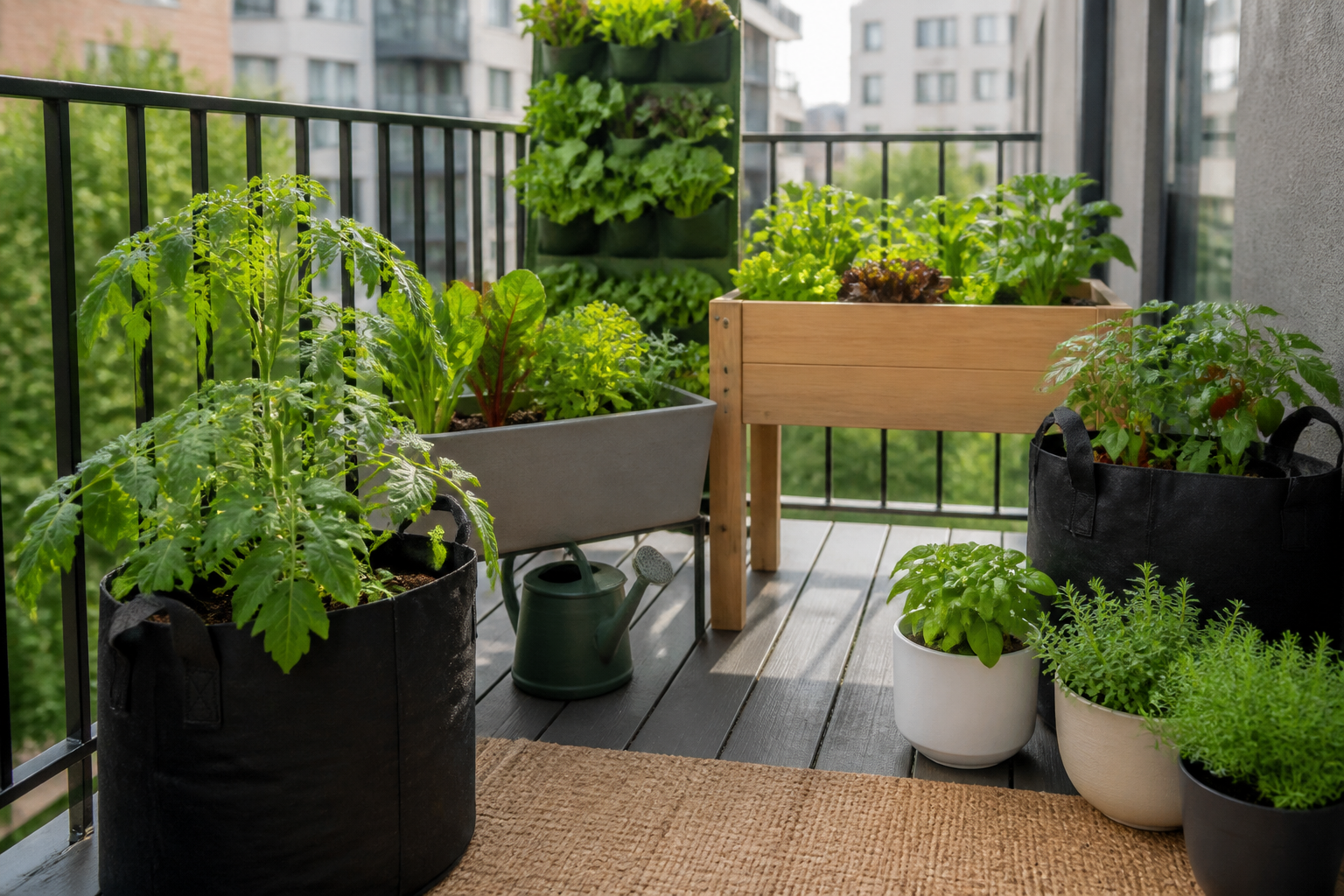
A productive apartment balcony garden begins with a realistic match between your light, available floor space, and watering habits, not with the largest kit that fits through the door. The best balcony vegetable garden kits and planters can make growing easier, but the right category depends on whether you want herbs for cooking, repeat-harvest salad greens, a few patio tomatoes, or a compact mix of vegetables.
For most beginners, the smartest purchase is not an all-in-one assortment with many seed packets. Start with a sturdy container solution, quality potting mix, and crops that fit the balcony’s conditions. A modest setup that receives the right light and is easy to water will usually be more useful than an elaborate kit that is too heavy, too shallow, or difficult to maintain.
Quick answer: which balcony garden setup should you choose?
| If your balcony situation is... | Start with... | Why it is the better fit |
|---|---|---|
| Sunny, with room for a few containers | Large fabric grow bags or deep individual planters | They give fruiting crops more root room and let you arrange plants around the sun. |
| Hot, sunny, and you cannot water frequently | Self-watering planters with overflow protection | A water reservoir can reduce day-to-day stress, although it does not eliminate the need to monitor moisture. |
| Part shade or only a few hours of direct sun | Shallow troughs, window boxes, or a raised salad planter | These are often a better match for leafy greens and many herbs than sun-hungry tomatoes. |
| Very narrow floor space but a sunny wall or corner | Vertical planter with a secure base | It can add planting pockets while preserving walking space; use it mainly for compact crops. |
| You rent and need a flexible setup | Grow bags, lightweight plastic planters, and trays | They are easier to reposition, clean up, and take with you when you move. |
| You want one tomato or pepper plant | A deep, stable planter plus a cage or trellis | One properly sized container is more useful than crowding a large plant into a shallow kit. |
Choose the planter type before buying a kit
Fabric grow bags: a flexible choice for sunny balconies
Fabric grow bags are a practical match for renters and gardeners who want to grow a limited number of larger plants. They are lightweight before filling, store flat between seasons, and come in shapes suited to individual vegetables or short rows of greens. Their flexibility is useful when you need to move containers as the sun shifts through the season.
- Best for: compact tomatoes, peppers, bush beans, cucumbers with support, potatoes, and herbs.
- Choose them when: you can water consistently and want the option to rearrange plants.
- Watch for: faster drying in sun and wind. Use a waterproof tray or protective mat if drainage could affect a lower neighbor or stain the balcony.
- Buying criterion: favor reinforced handles, a stable base, and a shape that fits the crop instead of simply choosing the highest pocket count.
Self-watering planters: best for a busy watering routine
Self-watering planters use a reservoir below the potting mix. They can be particularly helpful for thirsty herbs, greens, and warm-season vegetables when the balcony gets hot or you are not home every afternoon. They are not a cure for inadequate sun, poor drainage, or an undersized container, but they can make moisture levels less erratic.
- Best for: basil, parsley, lettuce, leafy greens, peppers, and compact tomatoes.
- Choose them when: watering is your biggest likely failure point.
- Watch for: reservoir access, a visible fill indicator if you prefer one, an overflow route, and total filled weight.
- Buying criterion: select a design that lets you check and refill the reservoir without dismantling the planting area.
Raised balcony beds: best for a small edible garden in one place
Elevated beds and raised salad planters make harvesting comfortable and keep a planting area organized. They are especially useful for greens, herbs, radishes, and other shallow-rooted crops. A deep raised bed can handle more ambitious vegetables, but it can become very heavy once filled and watered.
- Best for: cut-and-come-again lettuce, arugula, spinach, chard, radishes, scallions, and compact herbs.
- Choose them when: you want one neat growing station instead of several scattered pots.
- Watch for: loaded weight, drainage onto the balcony, and whether its legs sit securely on a level surface.
- Buying criterion: assess soil depth first. A shallow bed can be excellent for salads but is not automatically suitable for tomatoes, cucumbers, or larger root crops.
Vertical planters: best for preserving walking room
Vertical systems can turn a bright wall or corner into a useful herb-and-greens garden. Their main advantage is footprint efficiency, not unlimited capacity. Upper pockets may dry more quickly, while lower pockets can receive more runoff and shade. Choose a system you can comfortably water, inspect, and harvest from every level.
- Best for: lettuce, arugula, strawberries, small herbs, and compact trailing edible plants.
- Choose them when: floor space is scarce but you have a stable location with adequate light.
- Watch for: tipping risk, uneven watering, and building rules about attaching items to walls or railings.
- Buying criterion: prioritize a broad, stable base and access to every pocket over a tall design with hard-to-reach tiers.
Railing planters and window boxes: best for herbs and salad crops
Railing planters make use of otherwise unused space, but safety comes first. Use only products designed to fit your railing style, secure them as instructed, and confirm that your building permits them. Treat them as a place for lightweight, frequently harvested crops rather than the primary home for large tomato plants.
- Best for: herbs, leafy greens, radishes, and edible flowers.
- Choose them when: the railing receives useful light and the floor needs to remain clear.
- Watch for: secure mounting, wind exposure, water dripping below, and whether the planter interferes with an exit path.
The five buying checks that matter more than brand names
- Measure direct sun, not just brightness. Warm-season vegetables such as tomatoes and peppers generally need considerably more direct sun than greens. Track actual sun hours at the intended location before buying a large fruiting-vegetable planter.
- Calculate filled weight. Potting mix absorbs water, and containers become surprisingly heavy. Consider the planter, moist mix, plant supports, water reservoir, and mature plant together. When in doubt, choose several manageable containers instead of one oversized bed.
- Confirm drainage and runoff control. Every vegetable planter needs a way for excess water to escape. On a balcony, that also means planning for trays, saucers, or an integrated runoff solution that protects the surface and neighbors below.
- Buy enough root room for the specific crop. Herbs and salad greens can thrive in relatively small containers. Fruiting plants usually require more depth, volume, and stability. A visually attractive shallow planter is not a shortcut to a productive tomato harvest.
- Match the system to your maintenance capacity. A vertical garden with many pockets may look efficient, but it creates many small zones to water. A simple self-watering trough may produce more food for a gardener with a busy schedule.
Match crops to your balcony, not the other way around
| Balcony condition | Crops most likely to be rewarding | Planter approach |
|---|---|---|
| Six or more hours of direct sun | Compact tomatoes, peppers, bush beans, cucumbers with support, basil | Deep and stable individual containers, grow bags, or a substantial raised planter |
| Several hours of direct sun, especially morning sun | Lettuce, kale, chard, arugula, radishes, parsley, cilantro | Troughs, window boxes, shallow raised beds, or vertical pockets |
| Bright but mostly indirect light | Microgreens indoors, plus shade-tolerant herbs or greens outdoors where conditions allow | Keep the purchase modest; avoid buying a large tomato kit for this location |
| Very windy exposure | Low-growing greens, chives, parsley, thyme, compact herbs | Low, weighted planters placed away from the railing; avoid top-heavy towers |
| Intense reflected heat from concrete, glass, or brick | Heat-tolerant herbs and carefully monitored warm-season plants | Self-watering containers or larger containers that buffer moisture changes |
What should come with a useful balcony garden kit?
A good kit solves a real setup problem. It does not need to include everything. Bundled seeds, tools, labels, and decorative accessories may be less valuable than a durable planter with sound drainage and a design that fits your space.
- Worth paying for: a stable frame or container, drainage design, a reservoir where appropriate, a trellis or support that fits the planter, protective liners, and outdoor-rated hardware.
- Nice but optional: seed-starting inserts, plant labels, pruning snips, wheels, and a moisture indicator.
- Usually better purchased separately: quality potting mix, fertilizer suited to edible plants, crop-specific seeds or transplants, and supports sized for your chosen vegetables.
A practical starter plan for first-time balcony gardeners
If you are starting from zero, resist the urge to grow ten crops. Choose one low-friction plan and use the first season to learn how your balcony behaves in sun, heat, wind, and rain.
Plan A: the salad-and-herb balcony
- One rectangular self-watering planter or raised salad planter.
- Leaf lettuce, arugula, chard, parsley, and basil if sunlight is sufficient.
- Best for gardeners who want frequent harvests and modest space requirements.
Plan B: the sunny two-container balcony
- Two deep, stable planters or grow bags.
- One compact tomato or pepper plant in one container; bush beans, herbs, or greens in the other.
- Best for gardeners with reliable direct sun and a willingness to water often.
Plan C: the narrow-space vertical garden
- One secure vertical planter plus a small floor container.
- Use the vertical area for herbs and greens; reserve the floor container for one larger crop only if light allows.
- Best for balconies where walking space matters more than maximum harvest volume.
Common buying mistakes to avoid
- Buying for the photo rather than the crop. A tower full of mature tomatoes is not a realistic goal for every vertical planter.
- Ignoring wind. A lightweight planter can become unstable when a tomato, cucumber, or trellis catches a gust.
- Using garden soil from outdoors. Choose a container potting mix formulated to drain while holding moisture.
- Overplanting. Crowded plants compete for light, water, nutrients, and airflow. Fewer plants in appropriate containers often outperform an overcrowded kit.
- Forgetting water management. Hot weather, wind, small containers, and full sun can make daily watering necessary. Build your system around this reality.
- Skipping building and lease rules. Check applicable balcony load guidance and rules covering railing attachments, drainage, and exterior visibility before ordering.
Bottom line
The best balcony vegetable garden kit is the one that fits your balcony’s sun, structure, and routine. Choose a self-watering planter when consistent watering is difficult; choose grow bags or deep pots for a few sunny fruiting plants; choose a raised salad planter for greens; and choose vertical planters only when stability and access are genuinely good. Start with crops you will harvest often, then expand after one successful season.