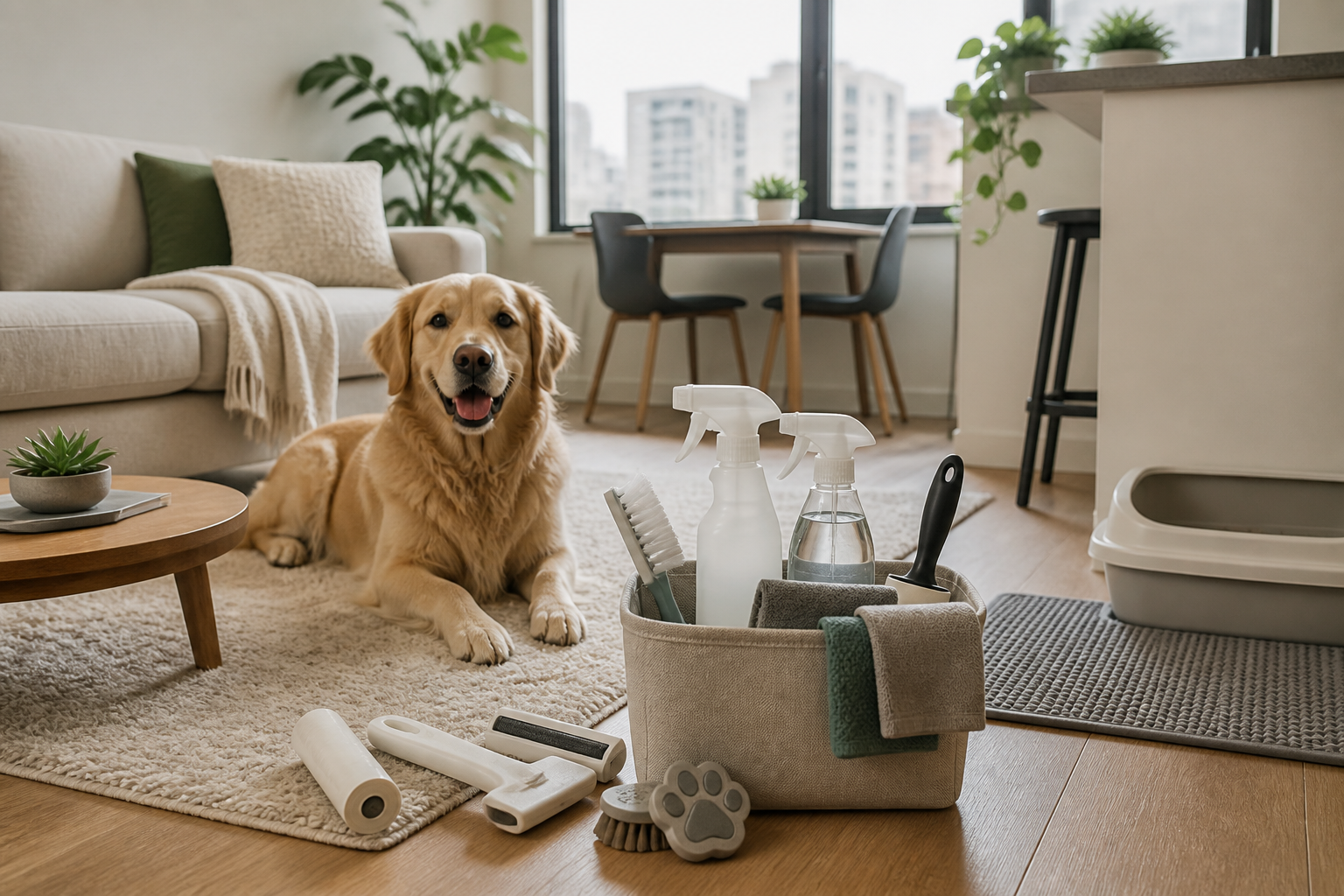
Pet messes feel bigger in an apartment because there is less distance between the litter box, sofa, rugs, entryway, laundry, and bed. The best answer is rarely one miracle cleaner. It is a compact, problem-specific kit that removes the mess at its source, fits your storage space, and is easy enough to use before a small issue becomes an all-weekend project.
The short answer: build your kit around the mess you fight most
For most pet owners in small homes, the highest-value starter kit has five parts: a reusable upholstery hair remover, a compact vacuum or dedicated pet-hair vacuum attachment, an enzymatic spot cleaner for organic accidents, a washable barrier such as a throw or couch cover, and a litter-tracking mat or floor-catching system.
Add an air purifier only when airborne hair, dander, or room-wide odor remains a concern after you have addressed the source. An air purifier is a supplement, not a substitute for cleaning upholstery, vacuuming, laundering washable fabrics, and promptly treating accidents.
| If your biggest frustration is... | Prioritize this first | Then add |
|---|---|---|
| Hair on the sofa, bedding, and clothes | Reusable fabric hair remover | Vacuum attachment and washable throws |
| Fresh or recurring urine accidents | Enzymatic pet stain and odor cleaner | Absorbent cloths, gloves, and a small extraction tool if needed |
| Litter granules throughout the apartment | Large textured litter mat | Litter scoop, sealed waste bin, and a handheld vacuum |
| Pet smell in one room | Source-cleaning kit for fabrics and floors | Ventilation and a correctly sized air purifier |
| Muddy paws and entryway dirt | Absorbent washable doormat or paw towel station | Spray mop or hard-floor cleaner approved for the surface |
| Fur and crumbs in tight spaces | Compact vacuum with crevice tool | Small storage caddy for daily-use tools |
How to choose the right apartment pet-cleaning kit
1. Buy for the surface, not just the stain
Before choosing a cleaner, identify where the mess actually lives. A product that works well on sealed tile may be unsuitable for unfinished wood, natural stone, delicate upholstery, or a washable couch cover. For urine, vomit, or feces, check that the product label specifically permits use on the surface you need to treat. Test cleaners on an inconspicuous area when the manufacturer directs you to do so.
For soft surfaces, the real question is depth. A surface-level spot on a flat-woven rug may only need blotting and a spot cleaner. A repeated accident on carpet padding, a foam cushion, or the inner layers of a pet bed may require more liquid, more dwell time, and more thorough drying than a quick spray can provide.
2. Favor low-bulk tools that get used often
In an apartment, an excellent cleaning tool that is too large to retrieve is often less useful than a small tool stored where messes happen. A hand vacuum can live near the litter area; a reusable hair roller can live beside the couch; and a lidded caddy can hold gloves, cloths, bags, and spot cleaner under the sink.
Look for cleaning tools with a clear home. If you cannot picture where it will be stored, charged, dried, or refilled, it may become clutter rather than a solution.
3. Separate removal from fragrance
Odor control works best when you first remove hair, waste, absorbed liquid, and residue. Fragrance can make a room smell different, but it does not automatically solve the cause of a recurring odor. For accident-prone pets, prioritize a cleaner designed for organic messes and use it according to its label directions. For litter areas, prioritize containment, daily waste removal, and floor cleanup before adding odor-control accessories.
4. Consider drying time in a small home
Slow-drying carpet, cushions, and pet beds are especially inconvenient when you have one living room and one favorite pet sleeping spot. When comparing options, consider whether you can open windows, run a fan, keep the pet away from the area while it dries, and avoid soaking materials that cannot be fully dried.
5. Make safety and label fit part of the purchase decision
Choose products intended for household use around pets only when used exactly as directed. Keep pets away from wet treated areas until the label instructions allow return, ventilate when the label calls for it, and never mix cleaners. If you live with birds or have a pet with a known sensitivity, take extra care with fumes and consult a veterinarian when appropriate.
The five core product categories worth buying
1. Upholstery hair remover: the everyday sofa tool
A reusable hair remover is often the best first purchase for apartment dwellers with cats or dogs that shed onto fabric furniture. It is quick, quiet, does not need charging, and can be used before guests arrive or before you sit down in dark clothing.
- Choose a reusable roller or brush for frequent sofa, chair, comforter, and pet-bed touchups.
- Choose a rubber squeegee-style tool when hair is embedded in low-pile carpet or vehicle upholstery.
- Choose disposable lint sheets mainly for clothing, lampshades, and small finishing jobs—not as your primary pet-hair system.
Decision rule: if the hair is visible every day on upholstery, buy a reusable tool first. If it is packed into carpet edges and under furniture, put more of the budget toward vacuum reach and attachments.
2. Compact vacuum: the tool that prevents buildup
For small homes, compare vacuums by behavior rather than by headline claims. Can it pick up litter scatter without constantly clogging? Does it include a crevice tool for baseboards and couch seams? Is the dustbin simple to empty? Can it reach under the bed where fur gathers? A lightweight stick vacuum, handheld vacuum, or a combination of the two can make more sense than a large machine if storage is limited.
- For litter tracking, look for a nozzle that can handle granular debris and a bin that empties cleanly.
- For furniture hair, prioritize a motorized upholstery tool or fabric-focused attachment.
- For long hair, check whether the brush roll is designed for easier hair removal.
- For frequent quick cleanups, consider charging location and battery access before purchase.
Do not expect a compact vacuum to replace deep treatment for a soaked carpet accident. Vacuuming handles dry debris and hair; extraction and appropriate spot treatment address embedded liquid messes.
3. Enzymatic spot cleaner: for accidents, not every cleaning job
For urine, vomit, and other organic pet messes, an enzymatic cleaner belongs in the emergency portion of the kit. The key is not simply owning one; it is using enough product to reach the affected material, allowing the label-directed time, and fully drying the area. A lightly misted surface may not reach odor residue that has traveled into carpet backing or cushion foam.
- Remove solid material and blot up as much liquid as possible without scrubbing it farther into the fabric.
- Check the label for suitability on the specific carpet, upholstery, bedding, or hard surface.
- Apply and allow the product to work for the stated time.
- Keep the pet away while the treated area is wet and drying.
- Reassess after the material is fully dry; recurring odor may mean the affected area is deeper or larger than it first appeared.
Decision rule: choose a ready-to-use spray for small, occasional incidents. Consider a larger refill format or an upholstery/carpet extraction option only if accidents are frequent enough to justify storage and drying time.
4. Washable couch cover or throw: the mess-prevention purchase
A washable barrier is one of the least glamorous and most effective apartment purchases. It reduces how often you need to clean the couch itself, protects favorite pet sleeping zones, and gives you a defined laundry routine. The right option is the one that stays in place, can be washed at home, and is inexpensive enough that you will not hesitate to use it.
- Choose a fitted cover if your pet treats the whole couch as a bed.
- Choose a washable throw for one favorite cushion or chair.
- Choose a waterproof or water-resistant layer when accidents, drool, or muddy paws are part of the problem.
- Keep a second cover or throw so one can be in the wash without leaving furniture unprotected.
Measure your furniture before shopping. A too-small cover that slips off every day is not a bargain.
5. Litter-area containment setup: stop the spread at the source
Litter tracking is a systems problem. The best setup is usually not a single mat; it is a sufficiently large mat positioned on the exit side, a scoop that is comfortable enough to use daily, a nearby sealed waste solution, and a vacuum or dustpan for escaped granules.
Choose a mat based on your cat’s exit pattern and the litter type. A shallow, wide mat can be better for a cat that steps out gently. A deeper textured mat may catch more particles from a cat that launches out of the box. Avoid a texture your cat dislikes enough to make the box area stressful.
When an air purifier is worth adding
An air purifier can be a sensible add-on for a studio, bedroom, or main living area with persistent airborne hair and dander concerns, but it should be matched to the room where the pet spends time. Compare the manufacturer’s stated room coverage carefully, and remember that filter replacement is part of the ongoing cost.
For apartment use, look for a unit that is practical at a lower fan speed, has accessible replacement filters, and can fit with adequate clearance rather than being hidden behind furniture. If odor persists, revisit litter maintenance, washable fabrics, accident treatment, and trash handling first. Air cleaning is most useful as one layer of a broader routine.
Apartment kit recommendations by pet situation
For a shedding cat in a studio
- Reusable upholstery hair remover
- Compact vacuum with crevice tool
- Wide litter-trapping mat
- Sealed litter waste bin or odor-limiting disposal setup
- Two washable throws for the bed or sofa
For a dog with occasional indoor accidents
- Enzymatic spot cleaner approved for carpet and upholstery
- Absorbent washable cloths or disposable absorbent towels
- Gloves and waste bags in a small accessible caddy
- Water-resistant washable furniture barrier
- Compact carpet or upholstery extractor only if accidents are recurring
For a multi-pet apartment with hair everywhere
- Full-size or stick vacuum with a hair-focused upholstery attachment
- Reusable fabric hair remover in the living room
- Washable covers for the most-used furniture
- Separate litter-area mat and handheld vacuum
- Optional air purifier sized for the main shared room
For renters trying to protect the security deposit
- Fast-access accident kit near the pet’s usual area
- Machine-washable runners or throws for high-risk zones
- Floor cleaner compatible with your flooring type
- Entryway mat and paw towel station
- Documentation of pre-existing stains or damage before move-in
What to skip or buy cautiously
- Oversized cleaning gadgets: Skip them if they will not fit in your closet or if setup makes you avoid using them.
- Heavy fragrance as the main odor strategy: Treat the source first. Strong scent can make it harder to tell whether the problem is actually resolved.
- One cleaner for every material: Floor finish, upholstery, rug fiber, and pet bedding can have different care requirements.
- Too-small litter mats: A mat that only catches the first step may not help a fast-moving cat.
- Disposable-only hair removal: It can be useful for travel and clothing, but recurring shedding usually justifies a reusable tool.
- Disinfectant by default: Routine cleaning is often the appropriate baseline; use disinfectants only as directed and when the situation calls for them.
A realistic weekly apartment pet-cleaning routine
- Daily: Scoop litter or remove waste promptly, wipe visible paw messes, and use the upholstery hair remover on favorite pet spots.
- Two or three times weekly: Vacuum the litter zone, sofa seams, rugs, and the pet’s preferred sleeping areas.
- Weekly: Wash throws, pet bedding, and washable covers according to their care labels; damp-clean hard floors as appropriate.
- Immediately after an accident: Blot, treat with the correct surface-safe product, and dry thoroughly.
- Monthly: Move lightweight furniture to clean hair buildup, inspect couch cushions and rugs, and wash or replace vacuum filters according to the manufacturer’s instructions.
Final buying checklist
- Does this solve a problem I have at least weekly?
- Is it approved for the surface I need to clean?
- Can I store it within a few steps of where I will use it?
- Can I wash, empty, recharge, or refill it without creating another chore?
- Will my pet be able to avoid the area while a cleaner dries?
- For repeat purchases, have I checked the cost and availability of refills, bags, filters, or replacement covers?
The best pet-mess kit for an apartment is small, specific, and repeatable. Start with the category that addresses your most frequent mess, then add only the tools that close a clear gap in your routine. That approach keeps your home cleaner without turning a closet into a warehouse of barely used products.