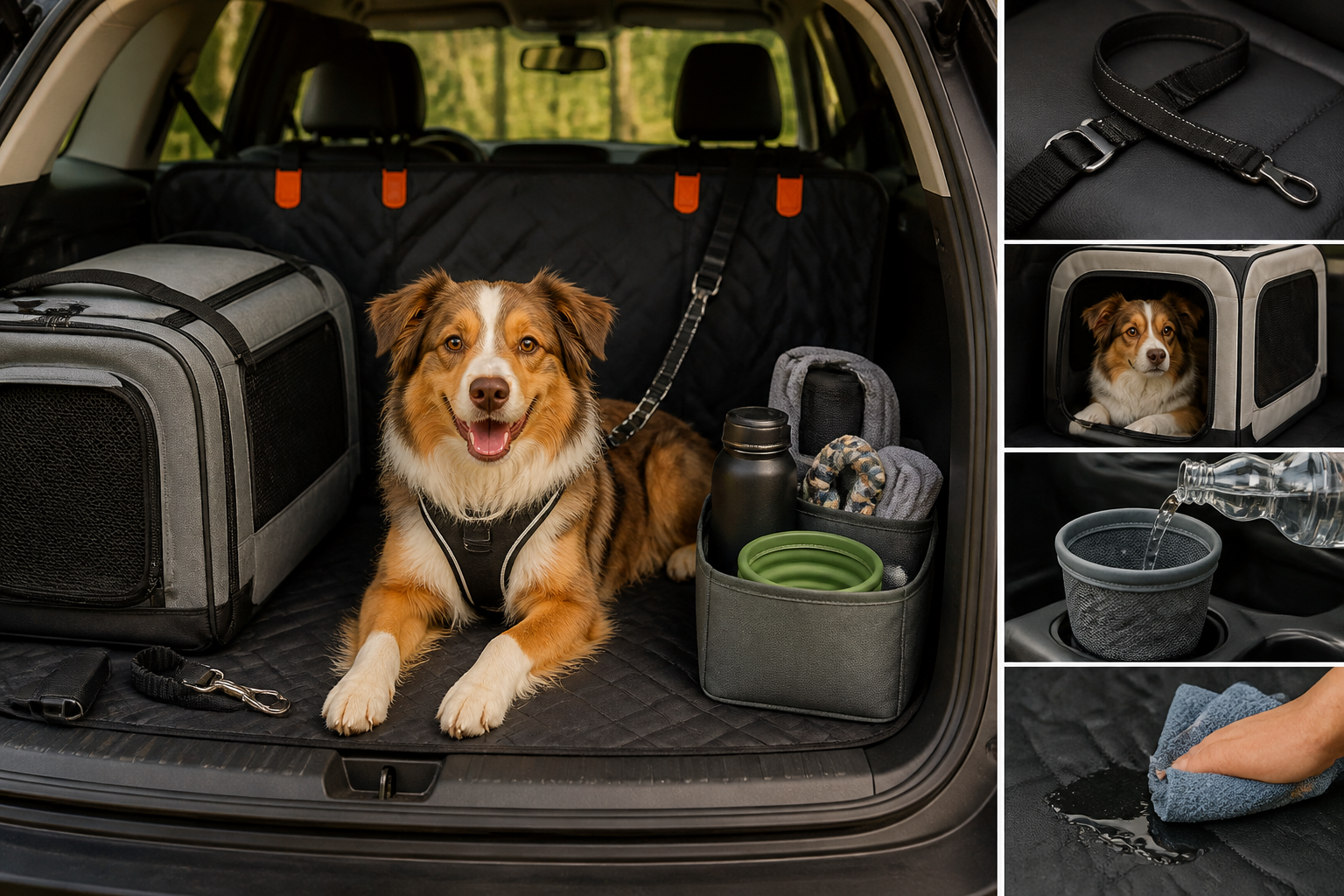
Good dog travel gear does more than make the back seat look tidy. The right setup can reduce driver distraction, make rest stops easier, contain muddy paws and shedding, and give your dog a predictable place to settle. Start with restraint or containment; add comfort and convenience products only after that foundation is covered.
For road trips, a dog should ride in the back seat or a secured cargo-area setup rather than loose in the cabin or in the front-seat airbag zone. For air travel, do not buy a carrier based on a generic “airline approved” label alone: airline rules vary, and cabin pets may need to fit in a carrier under the seat in front of you. ([aaa.com](https://www.aaa.com/pettravel/pet-travel-tips/Driving-With-Your-Pet?utm_source=openai))
Start with your travel profile
The best product type depends on your dog, vehicle, and trip—not on which accessory looks most convenient online.
| Your situation | Best starting point | Key buying priority |
|---|---|---|
| Medium or large dog in a sedan or SUV | Crash-tested harness or a secured travel crate | Verified compatibility with your dog’s measurements and your vehicle’s restraint points |
| Small dog who settles well in enclosed spaces | Secured carrier | Stable base, secure closure, ventilation, and manageable carry weight |
| Muddy, shedding, or wet dog on frequent drives | Seat cover plus a separate restraint | Coverage, non-slip backing, door protection, and access to seat-belt anchors |
| Cabin flight with a pet | Airline-compliant soft-sided carrier | Your specific airline’s current under-seat dimensions, ventilation, and pet policy |
| Long summer drives or remote routes | Portable water system and cleanup kit | One-hand use, leak resistance, easy cleaning, and spare water capacity |
| Dog that is new to travel or easily overstimulated | Familiar bedding, training plan, and low-fuss comfort accessories | Gradual acclimation rather than relying on a product to solve distress |
1. Dog car restraint: the purchase that deserves the most scrutiny
A travel harness, carrier, or crate is not interchangeable with a walking harness, booster, barrier, or seat cover. A barrier may help limit access to the front seat, and a cover protects upholstery, but neither is a substitute for a restraint system.
If you choose a car harness, look for evidence that goes beyond phrases such as heavy-duty, safety tested, or crash tested. The stronger signal is independent certification tied to the specific product and size. The Center for Pet Safety maintains a list of independently certified harnesses, carriers, and crates, and its harness criteria consider factors such as how far the crash-test dog moves during dynamic testing. ([centerforpetsafety.org](https://www.centerforpetsafety.org/cps-certified/?utm_source=openai))
Harness checklist
- Verify the exact model and size: a broad marketing claim is not proof that every version was tested or certified.
- Measure before ordering: use the manufacturer’s neck, chest, and weight guidance. A poor fit can let a dog slip out or concentrate pressure in the wrong place.
- Check the connection method: confirm whether the system uses the vehicle seat belt directly, a supplied restraint, or a vehicle-specific attachment.
- Avoid long, loose tethers: extra length can allow more movement. Follow the manufacturer’s installation directions rather than improvising with a leash.
- Prioritize back-seat use: keep dogs away from front airbags and the driver’s space. ([aaa.com](https://www.aaa.com/pettravel/pet-travel-tips/Driving-With-Your-Pet?utm_source=openai))
Best for: dogs that dislike crates, families with limited cargo room, and owners who need a setup that can stay installed between trips.
Skip it if: your dog panics in a harness, can escape its fitted size, or needs a more enclosed environment to remain calm. A properly secured crate or carrier may be the better route.
2. Travel crates and car carriers: choose containment, then secure it
A crate can be an excellent travel choice when the dog is already crate-comfortable and your vehicle can accommodate the correct size. For basic fit, your dog should be able to stand, turn around, and lie down comfortably. The crate must then be secured so it does not slide or tip during normal driving or sudden braking. ([akc.org](https://www.akc.org/public-education/resources/general-tips-information/travel/?utm_source=openai))
What to compare
- Interior size: roomy enough for normal repositioning, but not so oversized that the dog is thrown around inside.
- Vehicle footprint: measure the usable cargo floor or back seat, including hatch clearance and the space needed to load the crate.
- Anchoring plan: buy only after you know how it will be restrained in your specific vehicle.
- Door security: choose positive latches that are difficult for a dog to work loose.
- Ventilation: look for airflow on more than one side and avoid blocking vents with blankets or luggage.
- Cleanability: removable, washable pads and a contained base matter more on multi-day trips than plush trim.
For small dogs, a car carrier can be more practical than a large crate. Favor a stable, low-profile carrier that can be secured as directed. Do not assume a raised booster-style product provides crash protection unless that specific product has credible independent evidence for that use.
3. Dog seat covers: buy for containment and cleaning, not crash safety
A good seat cover protects the cabin, reduces the cleanup burden, and can keep a dog from slipping on leather or fabric upholstery. It is a convenience purchase, but it becomes especially valuable when paired with a correctly installed harness or carrier.
Choose the cover style for the problem you actually have
| Cover style | Best for | Watch for |
|---|---|---|
| Hammock-style back-seat cover | Containing hair, dirt, and dropped toys; discouraging forward movement | Whether it still leaves usable seat-belt access for your restraint system |
| Bench-seat cover | Dogs traveling in a harness with easy access to seat-belt buckles | Door-side gaps and exposed seat edges |
| Cargo liner | SUVs and wagons using a secured crate or cargo-area setup | Fit around folded seats, tie-down points, and hatch threshold |
| Door protectors | Dogs that lean on doors, drool near windows, or scratch trim | Attachment security and whether windows remain unobstructed |
Look for a non-slip underside, waterproof or water-resistant layering, seat-anchor straps, and machine-washable construction. Most importantly, make sure the cover does not interfere with restraint installation.
4. Portable water gear: prevent spills without making hydration inconvenient
For a long drive, the most useful water gear is the system you will actually use at stops. Pack your dog’s normal water when possible, plus a portable bowl or bottle that can be rinsed quickly. The AKC recommends carrying fresh water and a portable dish, planning regular stops, and remembering that drinking means your dog will need bathroom breaks too. ([akc.org](https://www.akc.org/expert-advice/travel/dog-comfortable-car-rides/?utm_source=openai))
Pick one of these approaches
- Squeeze bottle with attached drinking tray: best for quick roadside use with one dog. Check that unused water can return to the bottle or be discarded cleanly.
- Collapsible bowl plus insulated water bottle: best for multiple dogs, larger dogs, and owners who want the simplest parts to wash.
- Travel water jug plus bowl: best for all-day drives, hot weather, and routes with uncertain stop options.
Skip novelty dispensers with narrow channels or many non-removable parts if you need easy sanitation. A modest, leak-resistant bottle and a durable bowl are usually the better long-term buy.
5. Comfort accessories: support routines, not medical claims
Comfort items are useful when they make the travel environment more familiar: a washable blanket that smells like home, a favorite durable toy, a shade, or a cooling-safe travel mat used according to its instructions. Take short practice drives before the major trip so the dog can learn the restraint or carrier without the pressure of departure day. ([akc.org](https://www.akc.org/expert-advice/travel/tips-car-rides-canines/?utm_source=openai))
If your dog has severe travel distress, vomiting, respiratory concerns, or a history of panicking in confinement, speak with your veterinarian before the trip. Do not treat a calming chew, spray, or collar as a guaranteed solution, and do not use sedating products for air travel without veterinary guidance. The AVMA advises discussing travel planning with a veterinarian, who can assess whether medication may be appropriate for the individual pet. ([ebusiness.avma.org](https://ebusiness.avma.org/files/ProductDownloads/mcm-client-brochures-travel-with-pet-2023.pdf?utm_source=openai))
6. Flying with a dog: buy the carrier after checking the airline
Air travel is the category where shoppers most often buy the wrong item first. “Airline approved” is a marketing shortcut, not a universal standard. Airlines can set their own pet restrictions, including carrier dimensions, cabin availability, fees, breed restrictions, age rules, and seating limitations. The U.S. Department of Transportation specifically advises travelers to check the carrier’s policies before travel. ([transportation.gov](https://www.transportation.gov/airconsumer/flying_with_pet?utm_source=openai))
Airline-carrier decision sequence
- Check your airline’s current pet page before shopping. Confirm cabin availability on every flight segment, dimensions, pet weight rules if applicable, and whether the carrier must be leak-proof or have specified ventilation.
- Measure the under-seat space for your itinerary. Aircraft and seat layouts can differ by route, so use the airline’s stated limit rather than a generic carrier category.
- Measure your dog in a natural resting position. The dog must be able to travel comfortably inside the carrier, not merely squeeze through its opening.
- Choose practical features. A structured but flexible frame, secure zippers, absorbent removable liner, ventilation panels, privacy flap, and luggage-handle pass-through can all be useful.
- Practice at home. Build positive, quiet carrier time before travel day.
Pets are distinct from trained service animals under U.S. air-travel rules. A service animal is a dog individually trained to perform work or tasks for a person with a disability; emotional-support and comfort animals are not treated as service animals under the DOT definition. ([transportation.gov](https://www.transportation.gov/resources/individuals/aviation-consumer-protection/service-animals?utm_source=openai))
For pets traveling as cargo or in other airline-handled arrangements, requirements can be more extensive. USDA guidance highlights kennel suitability, health and readiness, and notes that dogs and cats must be at least eight weeks old and fully weaned for air travel under its regulations. ([aphis.usda.gov](https://www.aphis.usda.gov/pet-travel/pets-on-planes/preparing-pets-air-travel?utm_source=openai))
7. The compact dog road-trip kit worth packing
- Properly fitted car restraint, secured carrier, or secured crate
- Seat cover or cargo liner that does not block restraint points
- Leash, backup leash, and collar with current identification
- Water bottle or jug and a portable bowl
- Food measured into daily portions, plus familiar treats
- Poop bags, paper towels, enzyme cleaner, and a small trash bag
- Absorbent towels and a washable blanket or crate pad
- Vaccination and health paperwork where needed
- Any veterinarian-recommended medications, stored as directed
Before you buy: a five-minute checklist
- Measure your dog and your usable vehicle or under-seat space.
- Decide whether your first need is restraint, containment, cleanup, hydration, or comfort.
- For safety products, look for model-specific independent testing or certification—not vague wording.
- Confirm that all pieces work together: cover openings, harness connection, crate anchors, and vehicle layout.
- Practice the full setup on short drives before the long trip.
- For interstate or international travel, check destination requirements early. U.S. state and territory rules can differ and may involve health certificates, vaccinations, testing, or treatments. ([aphis.usda.gov](https://www.aphis.usda.gov/pet-travel/state-to-state?utm_source=openai))
Bottom line: Spend the most attention on the way your dog is restrained or contained, then choose a seat cover, water solution, and comfort items that fit that setup. Our recommended options below are organized by travel scenario so you can compare the gear that solves your actual problem instead of accumulating accessories that do not work together.