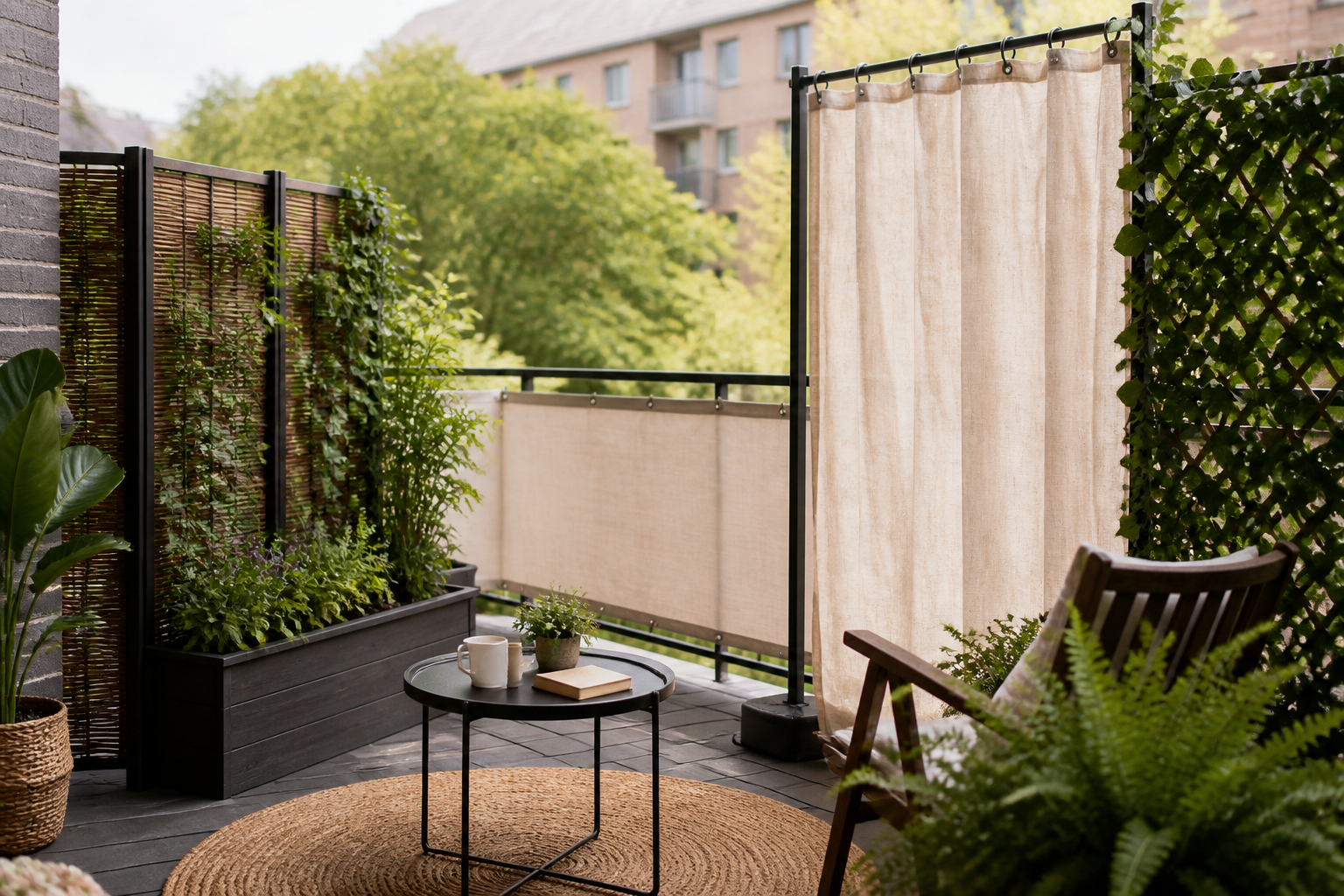
A balcony privacy project can be renter-friendly without being flimsy or turning a small outdoor area into an obstacle course. The best choice depends on the sightline you need to block: people looking through a railing, a neighbor facing one side of the balcony, or a ground-floor view into your seating area.
Start with the rules before you shop. A no-drill setup can still violate a lease, condo association rule, or property-management policy if it attaches to a railing, changes the exterior appearance, blocks drainage, or creates a wind hazard. Read your lease and balcony guidance, then ask management about any unclear restrictions. Keep doors, exits, building equipment, drains, and shared access clear.
Start with the privacy problem, not the product type
| Your main problem | Best starting category | Why it can work | Watch out for |
|---|---|---|---|
| People can see through or over the railing | Railing privacy screen | Uses the existing rail footprint and preserves floor space | Wind load, approved attachment points, drainage openings |
| A neighbor looks in from one side | Planter trellis or folding screen | Creates a vertical sightline break only where needed | Base stability and door clearance |
| You want privacy plus a garden | Large planter with trellis | Combines ballast, height, and planting space | Wet weight, drainage, and watering needs |
| You want temporary, adjustable coverage | Outdoor curtain or shade fabric | Can be opened when you want light and airflow | Wind exposure and permitted support points |
| You need instant greenery | Artificial vine or faux hedge panel | Provides immediate visual coverage without plant care | It still needs a stable, approved support |
Do not buy a complete privacy wall when one narrow sightline is the real issue. A targeted screen at the railing or one trellis planter at the exposed side usually feels more open, costs less, and is easier to remove when you move.
The buying rule that matters most: do not create a sail
A tall, solid panel on an exposed balcony can catch wind like a sail. That makes lightweight freestanding screens a poor default for upper floors, open corners, and locations that get regular gusts. A product can be marketed for outdoor use and still be unsuitable for your particular balcony.
Choose the smallest and most breathable option that solves the privacy problem. Lower-profile railing coverage, open trellis designs, and planter-supported screening are generally more conservative starting points than a tall opaque panel. “No drill” does not mean “no restraint”; it only means the setup does not require holes in the building.
Use this wind test before buying
- Sheltered: The balcony is recessed or protected on two or more sides. Railing screens, compact trellises, and curtains may be practical if the building permits them.
- Moderately exposed: You often feel gusts or lightweight furniture shifts. Favor breathable materials, multiple secure attachment points, and lower coverage rather than a broad solid panel.
- Highly exposed: Upper floors, waterfront settings, open corners, and regularly gusty locations call for a conservative approach. Avoid tall solid freestanding panels, and remove temporary textiles when severe weather is expected.
For garden privacy, the planter is part of the stability system. Extension guidance notes that heavier containers can help prevent top-heavy container plants from blowing over, while sun and wind can increase watering demands. That means a tall trellis needs realistic ballast and a realistic maintenance plan. ([]())
How to choose each no-drill privacy option
1. Railing privacy screens: best for preserving floor space
A railing screen is the most efficient choice when the privacy gap is at railing height. It adds a visual barrier without using valuable standing room, which makes it especially useful on narrow balconies.
- Buy this when: You need coverage from below or directly across the railing and have safe, approved places to attach it.
- Look for: Outdoor-rated fabric, reinforced edges, multiple attachment points, and dimensions that fit within the usable railing span.
- Measure carefully: Use the inside width of the railing, not only the overall balcony width. Account for posts, corners, gates, and the balcony door.
- Skip it when: Your building prohibits railing attachments, the fabric could interfere with drainage, or the balcony is so windy that a broad panel could strain its fasteners.
2. Planter trellises: best for privacy that feels like a garden
A trellis paired with a substantial planter creates a side screen and a planting zone at once. It remains portable at move-out, but it is not automatically light or easy to relocate once filled with moist potting mix and a mature plant.
- Buy this when: The privacy issue is concentrated on one side and you have enough depth for the planter while maintaining a useful walking lane.
- Look for: A trellis that connects securely to the planter, drainage holes, a broad base, and enough room for the mature plant.
- Choose plants deliberately: Match plants to your real sun exposure and your watering routine. Vining plants can be trained vertically on trellises, but a trellis does not make a shade-loving balcony suitable for sun-hungry plants.
- Start small: One trellis planter lets you test wind, light, and watering needs before committing to a perimeter full of containers.
Containers need drainage, and small-space container gardening can be a practical choice for balconies when the plant, container, and conditions are matched thoughtfully. ([]())
3. Weighted bases and freestanding screens: best for flexible layouts
A folding screen or standalone panel can help when only one chair or one edge of the balcony is exposed. Treat it as outdoor furniture, not as a structural wall. It needs a stable purpose-designed base, a manageable footprint, and a plan for storage or severe weather.
- Buy this when: You need targeted privacy on a sheltered balcony and can fold, move, or store the panel when needed.
- Look for: A low center of gravity, weather-suitable materials, and a base designed specifically for the panel.
- Avoid: Improvised weights perched on a base, loose items that can shift, and panels positioned in a doorway or walking route.
Required exits and access to exits should remain clear of obstructions. Do not turn a privacy project into a tripping hazard or a blocked escape route. ([fairfaxcounty.gov](https://www.fairfaxcounty.gov/fire-ems/node/272))
4. Outdoor curtains: best for adjustable privacy
Outdoor curtains are useful when you want privacy sometimes rather than all day. They can soften a hard balcony and allow more light when tied back, but they are among the least forgiving options in wind.
- Buy this when: You have a sheltered balcony and an existing, permitted support system.
- Look for: Outdoor-rated material, a way to restrain the bottom edge, and panels that can be tied back or removed quickly.
- Skip it when: Installation would require unapproved hardware, the balcony is exposed, or the fabric could obstruct a door, sprinkler, drain, or required access point.
5. Artificial vines and faux hedge panels: best for immediate coverage
Artificial greenery solves the waiting problem: there is no germination period, watering schedule, or bare first season. It works best as an accent on a stable frame rather than as dense material attached across every surface.
- Buy this when: You want instant coverage, have too little light for living plants, or need a temporary visual solution.
- Look for: Outdoor-use labeling, manufacturer UV-resistance information, easy-to-clean construction, and a support that is independently stable.
- Remember: Faux foliage does not remove wind, attachment, or fire-safety concerns. Check local and building-specific requirements, especially if the material will be close to a door, exit, or heat source.
Some fire codes and building rules place conditions on decorative vegetation and artificial greenery, particularly where it could obstruct egress. Verify the requirements that apply to your building rather than relying on a generic product listing. ([fairfaxcounty.gov](https://www.fairfaxcounty.gov/fire-ems/node/272))
Measure before ordering: five dimensions shoppers miss
- Privacy height: Sit in your usual chair and measure from the floor to the point where the unwanted sightline begins.
- Railing geometry: Note rail thickness, post locations, corners, gaps, and any top rail you are permitted to use.
- Door swing: Open the balcony door fully and mark the area it occupies before placing a planter or screen.
- Walking lane: Keep a practical route for laundry, groceries, watering cans, and emergency use—not merely enough room to squeeze past.
- Drainage and runoff: Identify drains and avoid placing fabric or containers where they can hold water, block flow, or drip onto another resident's area.
A practical shortlist by renter situation
| Situation | Best approach | Why |
|---|---|---|
| Narrow balcony with a standard railing | Railing screen plus small floor planters | Maximizes usable floor area |
| Ground-floor balcony with side exposure | One or two planter trellises on the exposed side | Creates a focused sightline break without enclosing the entire space |
| Windy upper-floor balcony | Low, breathable railing coverage or management-approved minimal screening | Reduces the risk of a tall solid panel catching gusts |
| Shade-heavy balcony | Artificial vine accent or shade-suited plants on a stable trellis | Avoids buying climbers that need more sun than the balcony receives |
| Temporary rental or frequent moves | Portable planter trellis or folding panel that stores flat | Moves more easily and avoids permanent alteration |
What to buy together—and what not to overbuy
The strongest privacy setups are usually modest systems rather than one oversized wall. Compare a screen with suitable attachment hardware, a trellis with a planter, or a curtain with a permitted support method. Do not assume fasteners included in a package are automatically appropriate for your railing, wind exposure, or building rules.
- A smart starter kit: One screen or planter trellis, compatible fasteners or supports, drainage management where appropriate, and a way to secure or store the setup during high winds.
- For a living screen: Add container potting mix, a watering can, and plants selected for your balcony's actual sun exposure. Containers dry out faster than in-ground beds and need drainage. ([]())
- Usually unnecessary: Covering every railing surface, purchasing multiple tall screens before testing wind, or adding more planters than you can water and move safely.
Bottom line
For most renters, the best no-drill balcony privacy choice is the least invasive option that solves one sightline safely. Start with a railing screen if floor space is scarce. Choose a planter trellis if you want privacy and gardening in one portable piece. Reserve freestanding panels and curtains for sheltered balconies where you can manage wind and keep the exit clear.
Prioritize written building approval when needed, measured fit, stable support, drainage, and a plan for windy weather before choosing color or decorative style. Those basics are what make a renter-friendly privacy idea practical through the season and easy to remove at move-out.