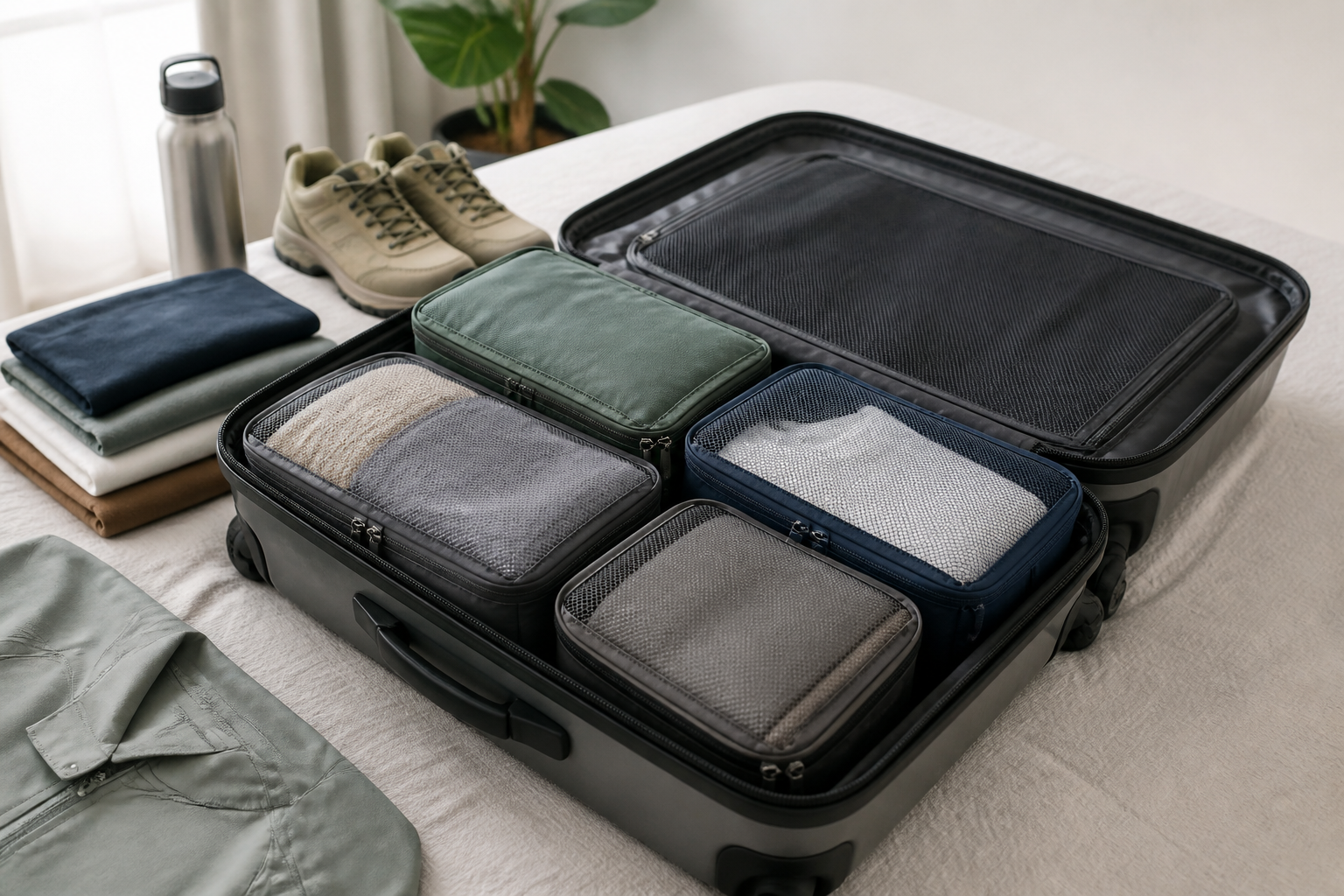
Compression packing cubes can be a smart addition to a carry-on suitcase or travel backpack, but they do not create extra space out of nowhere. Their real job is to reduce the bulk caused by trapped air in soft clothing, keep categories separated, and turn loose clothes into manageable blocks. Used well, they can make a small bag easier to pack and unpack. Chosen poorly, they can leave you with oversized cubes, strained zippers, awkward gaps, or a bag that closes but exceeds an airline weight limit.
For most carry-on travelers, the best choice is not necessarily the set with the most pieces. A lightweight set with coordinated sizes, a separate compression zipper, and dimensions that suit the usable interior of your suitcase is usually more practical. Compare a cube's measurements with the inside of your luggage, including the space lost to wheels, handles, dividers, and curved corners, rather than relying only on a bag's advertised carry-on label.
Understand the Difference Between Organization and Compression
A standard packing cube organizes clothing. A compression packing cube organizes clothing and uses a second zipper, usually around much of the perimeter, to flatten the filled cube after it has been closed. That second closure is the feature to look for. If a product has only one access zipper, it is likely a regular packing cube rather than a true zip-compression design.
Compression works best with soft, airy, and flexible items. Knit shirts, underwear, pajamas, leggings, lightweight sweatshirts, and synthetic layers often become more compact because air can be pushed out of the spaces between them. It is much less useful for jeans, shoes, rigid toiletry bags, chargers, or clothing that is already dense. A compression cube will not make a heavy pair of boots lighter, and it cannot turn a large winter coat into a small travel accessory without tradeoffs.
| Organizer type | Best for | Main benefit | Limitation to expect |
|---|---|---|---|
| Standard packing cubes | Short trips, low-bulk clothing, and simple organization | Lightweight and quick to access | They do not reduce the thickness of packed clothing |
| Zip-compression cubes | Carry-on bags filled with flexible clothing | They compact soft items while separating categories | They must not be overfilled before compression |
| Roll-up compression bags | Bulky clothing when volume matters more than access | They can remove substantial air from some garments | They are less organized, slower to access, and may increase wrinkles |
| Ultralight organizers | Travel backpacks and strict weight limits | They add very little empty weight | The fabric may provide less structure and protection |
What to Look for Before You Buy
Choose sizes that create a useful layout
For a carry-on suitcase, a three- or four-cube set is often more flexible than a set with six or eight tiny pieces. A useful starting combination includes one medium cube for shirts and light layers, one long or large cube for pants and longer garments, and one small cube for underwear, socks, or soft accessories. For a backpack, narrow and shallow cubes often use the compartment more efficiently than very wide models.
Measure the length and width of your bag's interior before shopping. Then sketch a simple layout: perhaps two medium cubes side by side, or one larger cube plus two smaller ones. The aim is not to fill every inch with rectangles. Leave a strip of space for a toiletry bag, a packable jacket, medications, documents, or other items you may need to reach quickly.
Prioritize a separate compression zipper
Look for a two-stage closure: one zipper to close the cube when it is full and another zipper to compress it. This design lets you load clothing evenly before reducing the profile. A compression zipper that runs around a large portion of the cube generally distributes tension more evenly than a short zipper placed on one side.
Check the zipper pulls as well. Easy-to-grip pulls matter when you need to open a packed cube in a cramped airplane seat, a dim hotel room, or late in a trip when your clothes are no longer folded neatly. Do not assume a stiff zipper is automatically durable; it can also be a sign that the cube is overstuffed or poorly aligned.
Balance lightweight fabric with durability
For carry-on travel, balance matters more than appearance. Lightweight fabric leaves more of your allowance for the items you actually need, while extremely thin material can distort under compression or wear at corners over time. Useful construction details include durable polyester or ripstop-style fabric, neatly finished seams, and mesh panels used where they add visibility or ventilation.
A fully mesh cube makes it easy to see what is inside, but it may offer less protection against snags. A partial mesh panel is often a practical compromise: it helps identify the contents without making the entire cube a more vulnerable surface. If you regularly pack rough outdoor gear or clothing with hooks and hardware, a less exposed design may be preferable.
Match the shape and opening to your clothes
Rectangular cubes with a wide opening are easier to fill in layers. If you roll casual clothes, choose a lid that opens far enough to arrange tidy rows. If you fold shirts, trousers, dresses, or long layers, a long and shallow cube can prevent an extra fold that creates a thick lump in the middle.
A large cube is not automatically better. When full, an oversized cube can become a rigid block that takes over a small backpack and makes remaining gaps unusable. Two medium cubes often adapt better to different bag shapes, changing itineraries, and partial packing on the return journey.
Consider weight, handles, and extras realistically
Do not pay for extras you will not use. A side handle can make it easier to remove a cube without disturbing the rest of the suitcase. A dirty-laundry compartment can be helpful on longer trips, but it also adds material and weight. Shoe bags are useful for separating soles from clothing, yet they are not a replacement for a compression cube meant for soft garments.
If your fare includes a weight limit, weigh the empty set before committing to it. Compression can help more items fit by reducing volume, but it does not reduce the kilograms or pounds of what you pack. That is why a very rugged, heavily structured set is not always the best option for cabin-only travel.
Choose Cubes for Your Travel Style
| If your priority is... | Look for... | Avoid... |
|---|---|---|
| A weekend with a travel backpack | Two or three lightweight, narrow, medium cubes | Large sets with extra-large cubes |
| A week in a carry-on suitcase | Three compression cubes plus a separate toiletry bag | Too many small cubes that fragment your clothing |
| Winter or athletic clothing | Strong zippers, durable fabric, and expandable profiles | Expecting compression to solve the problem of heavy garments |
| A work trip | Wide, shallow cubes for flatter folding | Over-compressing structured shirts or blazers |
| Traveling as a couple or family | Different colors, labels, or duplicate sets | Mixing everyone's clothing in oversized shared cubes |
A Three-Cube Strategy for Carry-On Luggage
This approach is often easier than forcing every item into one large compression cube. It keeps clothing accessible and makes it easier to decide what to remove before closing the suitcase.
- Medium daily-clothes cube: Pack T-shirts, tops, pajamas, and a light layer. Roll knitwear and casual items, or fold them evenly. Use a single method when possible so the cube stays level.
- Medium or long bottoms cube: Reserve this for pants, leggings, shorts, skirts, or dresses. Fold longer garments to the cube's length so you do not create a dense mound in the center.
- Small essentials cube: Use this for underwear, socks, swimwear, and soft accessories. This is the cube you are most likely to open during the trip, so place it near the top of the bag.
Keep shoes outside your main clothing cubes. Put them in a dedicated bag and position them near suitcase wheels or at the bottom of a backpack, depending on where they improve stability. Keep toiletries separate and accessible. If you need to remove them at a security checkpoint, you should not have to unzip and decompress all of your clothing in line.
How to Compress Without Damaging Zippers or Clothing
- Fill the cube only to the point where the main zipper closes without hard pulling.
- Spread thickness evenly. Do not place all socks or a rolled sweatshirt in one corner.
- Close the primary zipper completely.
- Lay the cube on a flat surface and use one hand to level the contents while closing the compression zipper.
- If the second zipper catches or resists sharply, stop. Open the cube, remove an item or redistribute the load, and try again.
A well-packed compression cube should close with moderate resistance, not a struggle. Repeatedly forcing an overloaded zipper can shorten its useful life and usually produces an awkwardly bulging package that fits the suitcase worse. Compression also has limits for wrinkle-prone clothing. Use it mainly for casual and soft garments, and keep delicate or structured pieces in a low-profile standard organizer when possible.
Common Mistakes That Waste Space
- Buying by piece count: More cubes do not automatically create a better packing system.
- Using only external measurements: Cubes must fit the usable interior around wheels, handles, and dividers.
- Compressing heavy items: You may create a dense bag that is harder to lift and easier to exceed weight limits with.
- Using one extra-large cube in a small bag: It can block access to everything else.
- Packing “just in case” because it fits: Compression improves volume, not the usefulness of every item.
- Ignoring airline rules: Carry-on size and weight allowances can differ by airline, route, aircraft, and fare, so confirm the rules for your specific flight before departure.
Bottom Line: What Set Is Worth Choosing?
For many travelers, the most sensible purchase is a set of three lightweight compression cubes in small, medium, and large or long sizes. Look for dual zippers, clean seams, comfortable pulls, and a partial mesh panel if seeing the contents matters to you. This setup can work for weekend trips, week-long carry-on travel, and itinerary changes without requiring you to bring organizers that go unused.
Choose an ultralight set when weight is your main concern. Choose more durable fabric and especially robust zipper construction when you frequently travel with winter layers, athletic clothing, or heavily used gear. If most of your wardrobe is structured or wrinkle-sensitive, combine one compression cube for soft clothing with a standard low-profile organizer for shirts, blazers, and other delicate items.
Before choosing a set, make one final check: measure your suitcase, consider the real bulk of your clothing, and decide how many categories you genuinely need to keep separate. With that filter, you are more likely to choose compression packing cubes that make packing easier instead of simply adding more gear to your luggage.